I do not know Jesus at all.
I have not met him.
Or been in touch with him.
They told me a lot about him when I was a child.
I remember thinking that he had a quite exciting life.
Then they tried to make me believe that he would return.
They also talked about his father. A lot.
This guy called God.
He was always in heaven.
My grandmother had a painting of a bearded quite handsome man sitting on a mountain overlooking a valley.
There was this halo on top of his head & he was wearing something resembling sheets. He had long brown soft hair.
I never really could get if he was jesus or God.
The same guy was also appearing in a picture where he was escorting two small children over a bridge.
Probably because a thunderstorm was about to start.
I do not know. Was that Jesus?
When I grew older I heard that he died on a cross.
Mel Gibson made a crappy 3 hour movie about this. Watching it was like torture.
Then I heard that Jesus never died on that cross. That some people rescued him & took him to India.
Or Spain. Or Japan.
What ever. It's all very confusing.
Anyway, with a mature skepticism I have to admit that all these bible stories are just that - stories.
I get the point that it's nice to believe in something. Let's say when you're sad and you don't have anyone to call then it's quite comforting to talk to an imaginary character like God or Jesus.
And it's even better because loads of other people also do that.
But why on earth do some people think that a problem is solved because we talk to an imaginary man?
I guess it can give strength - it's sort of similar to meditation...
So, let's then think about why people who truly believe in these guys, Jesus & God, why are they so against people with other believes?
Why can't they love other people with other values and ideas?
Why do they believe they are right just because they believe their God is the right God?
Throughout history the men of God & Jesus have committed terrible bloody crimes.
it does not seem like a system I want to support. Unfortunately. Sorry about that.
Saturday, 18 February 2012


Why is Steven making me feel lousy?
so I just must write.
it does not matter if its good or bad. I need to write.
because this book is telling me to. writing is my work.
what else is my work?
coming up with ideas and filming them. making photographs and videos.
writing. doing research on different topics and things.
collecting data. collecting things that give me new ideas.
looking at things.
writing about things. and feelings.
as for today. I was feeling a bit down, weak and tired. hung over sort of without a reason.
at some point I told myself to pull myself together and work. at least do something.
that I can not come up with excuses.
its all from this book. talking about fucking resistance…Steven Pressfield…
first I was nodding. knowing he is right of course. then I realized that no shit, I don't need to read this book because I am all ready doing all these things. I am the pro.
But why the hell did Steven manage to make me feel guilty?
And a bit uneasy. A bit unsure about my methods of working.
Perhaps its more rotten than I think.
I mean I always every now and then make to do lists. I submit stuff to different places. I meet people. I talk to them. I hand out cards.
I write a bit now and then. I upload videos. I edit videos.
I watch films and documentaries to find inspiration. to come up with new image ideas. I write about my upcoming work. I write scripts.
But i have no daily "ordnung"…things just sort of happen.
things just sort of get done.
isn't that good enough?
or do I need to have that career talk with myself?
a critical review of my career. nina the boss meets nina the co-worker. the secretary. the housewife. the editor, the creative writer. the AD. nina the fucking queen of her empire….
if my empire seems to be working why am I reading Stevens book?
Why is Steven making me feel lousy?
Well, now at least Steven made me write. And Steven is going to make me do a work about his book.
I cant resist that.
hear: "the professional shuts up. She doesn't talk about it. She does her work."
oh Steven oh Steven.
sometimes we need to talk about it. To remember why we started doing these things. Why we chose this work. Then we can do the work again.
And develop within our work. Development does not only happen through technical improvements.
it does not matter if its good or bad. I need to write.
because this book is telling me to. writing is my work.
what else is my work?
coming up with ideas and filming them. making photographs and videos.
writing. doing research on different topics and things.
collecting data. collecting things that give me new ideas.
looking at things.
writing about things. and feelings.
as for today. I was feeling a bit down, weak and tired. hung over sort of without a reason.
at some point I told myself to pull myself together and work. at least do something.
that I can not come up with excuses.
its all from this book. talking about fucking resistance…Steven Pressfield…
first I was nodding. knowing he is right of course. then I realized that no shit, I don't need to read this book because I am all ready doing all these things. I am the pro.
But why the hell did Steven manage to make me feel guilty?
And a bit uneasy. A bit unsure about my methods of working.
Perhaps its more rotten than I think.
I mean I always every now and then make to do lists. I submit stuff to different places. I meet people. I talk to them. I hand out cards.
I write a bit now and then. I upload videos. I edit videos.
I watch films and documentaries to find inspiration. to come up with new image ideas. I write about my upcoming work. I write scripts.
But i have no daily "ordnung"…things just sort of happen.
things just sort of get done.
isn't that good enough?
or do I need to have that career talk with myself?
a critical review of my career. nina the boss meets nina the co-worker. the secretary. the housewife. the editor, the creative writer. the AD. nina the fucking queen of her empire….
if my empire seems to be working why am I reading Stevens book?
Why is Steven making me feel lousy?
Well, now at least Steven made me write. And Steven is going to make me do a work about his book.
I cant resist that.
hear: "the professional shuts up. She doesn't talk about it. She does her work."
oh Steven oh Steven.
sometimes we need to talk about it. To remember why we started doing these things. Why we chose this work. Then we can do the work again.
And develop within our work. Development does not only happen through technical improvements.
Thursday, 2 February 2012
Mike Kelley is dead.
Suicide some say. Feels strange to hear that this artist was so fed up with the art world. Or that it sort of killed him. Or did it? Well, at least it disappointed him greatly.
But Fontana, who saw Kelley last week for dinner, said that Kelley's art-world accomplishments had a price, as he had been actively struggling with what it means to succeed in a world that has become more materialistic and foreign to him.
"He had a deep discomfort in seeing what the art world is now," Fontana said. "He didn't like the fact that everything has become so corporate. He said to me: 'If I were to start now, I would never become a visual artist.'
And here we are - going on…trying to convince ourselves that what we do is important. At least its fun.
And then i read that there was this one woman, Fontana, who quit her job as an art historian because of Kelleys work. Why was that not enough? What was his idea of success? What is our idea of success? Why are we human beings so obsessed with success and succeeding? I mean, isn't the fact that somebody is touched by what we do a success in itself?
Yes, it is sometimes difficult working and maintaining a somewhat serious and emphatic position in the art world when it at times seems mostly superficial and ugly. But then isn't it time to re-position? To create ones own world and stick to that? Or what is the best strategy?
"He really wanted to be an important artist, and he worked all of his life for that. He found himself at the top of his game and then found that the world he was at the top of was a world that he didn't like. That's intense existentially."
I do also feel the need of being part of something that is important. Of doing things that feel important to me. And hoping that others will find it important. But then I do already know that I don't like the so called art world so much. I like many of the artists that I meat. I probably like many curators and gallerists too. I just dont seem to meet so many of them…why is that? Is my work not important enough. Or then Im not sexy enough. Or something. I have no clue. But then I say - rather this way than no way.
the rest remains to be seen.
But Fontana, who saw Kelley last week for dinner, said that Kelley's art-world accomplishments had a price, as he had been actively struggling with what it means to succeed in a world that has become more materialistic and foreign to him.
"He had a deep discomfort in seeing what the art world is now," Fontana said. "He didn't like the fact that everything has become so corporate. He said to me: 'If I were to start now, I would never become a visual artist.'
And here we are - going on…trying to convince ourselves that what we do is important. At least its fun.
And then i read that there was this one woman, Fontana, who quit her job as an art historian because of Kelleys work. Why was that not enough? What was his idea of success? What is our idea of success? Why are we human beings so obsessed with success and succeeding? I mean, isn't the fact that somebody is touched by what we do a success in itself?
Yes, it is sometimes difficult working and maintaining a somewhat serious and emphatic position in the art world when it at times seems mostly superficial and ugly. But then isn't it time to re-position? To create ones own world and stick to that? Or what is the best strategy?
"He really wanted to be an important artist, and he worked all of his life for that. He found himself at the top of his game and then found that the world he was at the top of was a world that he didn't like. That's intense existentially."
I do also feel the need of being part of something that is important. Of doing things that feel important to me. And hoping that others will find it important. But then I do already know that I don't like the so called art world so much. I like many of the artists that I meat. I probably like many curators and gallerists too. I just dont seem to meet so many of them…why is that? Is my work not important enough. Or then Im not sexy enough. Or something. I have no clue. But then I say - rather this way than no way.
the rest remains to be seen.
Monday, 5 December 2011
Cat thinks people not living life to the full

Cat thinks people not living life to the full: but I think we still need each other.
Publication: C: International Contemporary Art
Publication Date: 22-JUN-08
Author: Wren, Jacob
COPYRIGHT 2008 C The Visual Arts Foundation
In the book Recording Conceptual Art (University of California Press, 2001), a series of interviews with key conceptual artists all conducted in 1961 but unpublished until 2001, Robert Barry speaks about his now well-known projects involving telepathy--works that attempted to bypass "any kind of material, even words or language," explaining that
The best telepathic transmission sort of takes place
unconsciously, where you don't even know you're
doing it. So that the latest of the telepathic pieces,
we just assume that the ideas will be transmitted
telepathically, instead of consciously trying to
do it. [...] We just simply don't deal with that problem
of what it is that's being communicated. We just
say that something is communicated and that's all
there is to it. Now, I'm communicating it. Whether
anybody picks it up or not is something else. In
other words, I wouldn't say I'm communicating it;
I'd say I'm transmitting it. If someone picks it up,
then that's communication. Someone might pick it
up rive minutes before I've thought about it. You see,
because that sort of transcends time and space, and
these things sort of exist for all time, so to speak.
It's difficult to imagine anyone trying to pull off such an audaciously flaky idea today. The fact that the artist actually doesn't do anything, transmits something without making any effort, and yet the work of art in some sense still exists, seems to verge dangerously close to a style of charlatanism much too obvious for out post-ironic times. Nonetheless, the specific manner in which this historically important work lathers up my scepticism suggests that he may well have been on to something, that this might be a radical gesture with a bit of spark still left in it. If we allow ourselves to be open enough, might a genuine belief in the paranormal--so far away from social norms but believed in by so many--be a strategy for refreshing the often too predictable contemporary artistic context? [ILLUSTRATION OMITTED] In her video Tele-pets (2006), Gothenburg-based Finnish artist Nina Lassila takes a different approach to telepathy. The video begins with the artist speaking in voiceover:
As other people, I also like to talk to animals.
Sometimes I feel that they are responding. I
wonder what they are thinking ... I have heard
that there are people who can communicate with
pets and other animals. Obviously many animals
have a lot to say. I want to find out what ...
The voiceover goes on to document a variety of instances, stories the artist has gathered, of people's telepathic experiences with their pets. Underneath the sporadic but steady narration run images of these pets. (They could just be images of random dogs, birds, cats, horses and goldfish; there is no way to know for sure.) It could almost be a late-night infomercial advertising the possibility of a true telepathic encounter with your pet. But it couldn't be an infomercial, the tone is all wrong: the imagery too fragile, too elegant, too poetic. But then, what is the tone exactly? It is tempting to suspect that irony is at work here, that we are meant to slyly laugh at these lonely people who have nothing better to do than recount what messages their parrot or dog sends through the air and into their thoughts. However, upon repeated viewing, I gradually came to the counterintuitive conclusion that there is in fact little irony to be round here, only a generous sense of humour flowing out from an even more genuine sense of curiosity.
A woman is watching a picture of a purple car. A
moment later her parrot who is in another room
says: what a beautiful purple. The same parrot
wakes her up in the middle of the night, saying:
you gotta push the button! (The woman
was dreaming about editing.)
In its way, its very different way, Tele-pets is just as earnest and funny as Robert Barry's purely conceptual telepathy experiments from 1961. Because, just as Robert Barry's work encapsulated one extreme edge of a very dry first generation conceptualism, Nina Lassila's video equally pushes towards a similar edge, a similar breaking point, for the post-conceptualism of our time. This is an art that desires to stop talking about art, that doesn't take itself too seriously but nonetheless wants to let in a greater sense of the world, and scratch away at its strange, unexpected corners. I suspect it is also a type of art that would not be possible without the legacy of conceptualism. This makes for an unlikely mix: this work still possesses the distance associated with the conceptual legacy, while at the same rime it attempts to forge a much greater intimacy with its subjects, the people whose stories if recounts, and with the viewer. In a similar manner to that in which much first generation conceptual art asked, "what is art and how far can we go with it?" Tele-pets asks, "how can I use art to forge a greater sense of engagement with the world around me?" In the same 1961 interview, Robert Barry says that his work with telepathy "raises a lot of fundamental problems as far as the existence of a work of art is concerned: just how much is needed, and how much has to be known about a work of art, before it does exist. I think it questions the very being of any work of art" At first I was tempted to write that Tele-pets refuses to play such games and doesn't particularly care for fundamental problems of the "existence of a work of art." But upon further consideration, I think that it is only a matter of questioning art from another angle: not reducing art to its bare minimum and waiting to see what's left, but instead, with humour and a very light touch, placing art alongside these intimate, very human stories from daily life, and then taking art and life together and viewing them within the larger scale of the natural world.
An animal therapist writes about Tuatara lizards.
The species is very old. The lizards feel very uncomfortable
around humans. We move too fast.
For them time goes much slower. From the same
source I hear about a cat who can explain the
phenomenon of time. Time exists in layers, like
the pages of a book. The cat also thinks people
are not living life to the full...
Of course, Nina Lassila isn't nearly as famous as Robert Barry and most likely never will be. (She is still young, so anything is possible, but times have definitely changed.) This is another aspect of the kind of work I am writing about here, of which I believe Tele-pets is only one example. Radical artistic gestures feel played out; they will no longer make or break careers and maybe art careers themselves no longer feel so important, some flashes in the pan simply last longer than others. Robert Barry was interested in telepathy as a radical gesture in and of itself; Nina Lassila is interested in telepathy as a way to hear what the animals have to say. It may or may not be a generational divide, but these are clearly very different impulses. To discover something meaningful within the artistic context I wonder if it is now necessary to turn away from purely artistic questions, to look elsewhere, out into the greater world. Tele-pets ends with a final thought from the artist:
Our culture is based on the superiority of human
beings. The need to control is too big ... but I think
we still need each other.
As the video makes clear, it is people and animals that still need other. I suppose it is a sentimental thought, maybe pithy, possibly naive, but one certainly doesn't have to be receiving telepathic messages from the animal kingdom in order to sense its inherent truth. * Jacob Wren is a writer and maker of eccentric performances. His recent books include Unrehearsed Beauty (Coach House Books), Families Are Formed Through Copulation (Pedlar Press), Le genie des autres (Le Quartanier) and the upcoming novel Revenge Fantasies of the Politically Dispossessed.
Saturday, 19 November 2011
more greek memoires

"Virginity, virginity, where have you gone, leaving me abandoned?
No longer I will come to you, no longer will I come"
Sapfo
being here now all by myself the 4th day i realize I do not want to go and see or meet people.
I do not wish to speak about money.
I read the news every morning. I read about Greece and its debts.
I read about the protests. In Athens, on Wall street.
I know I should do something. Take action. At least react.
But now I rather see the ants getting drunk from spilt Ouzo on the terrace floor.
I rather spend time with the cats than think of money.
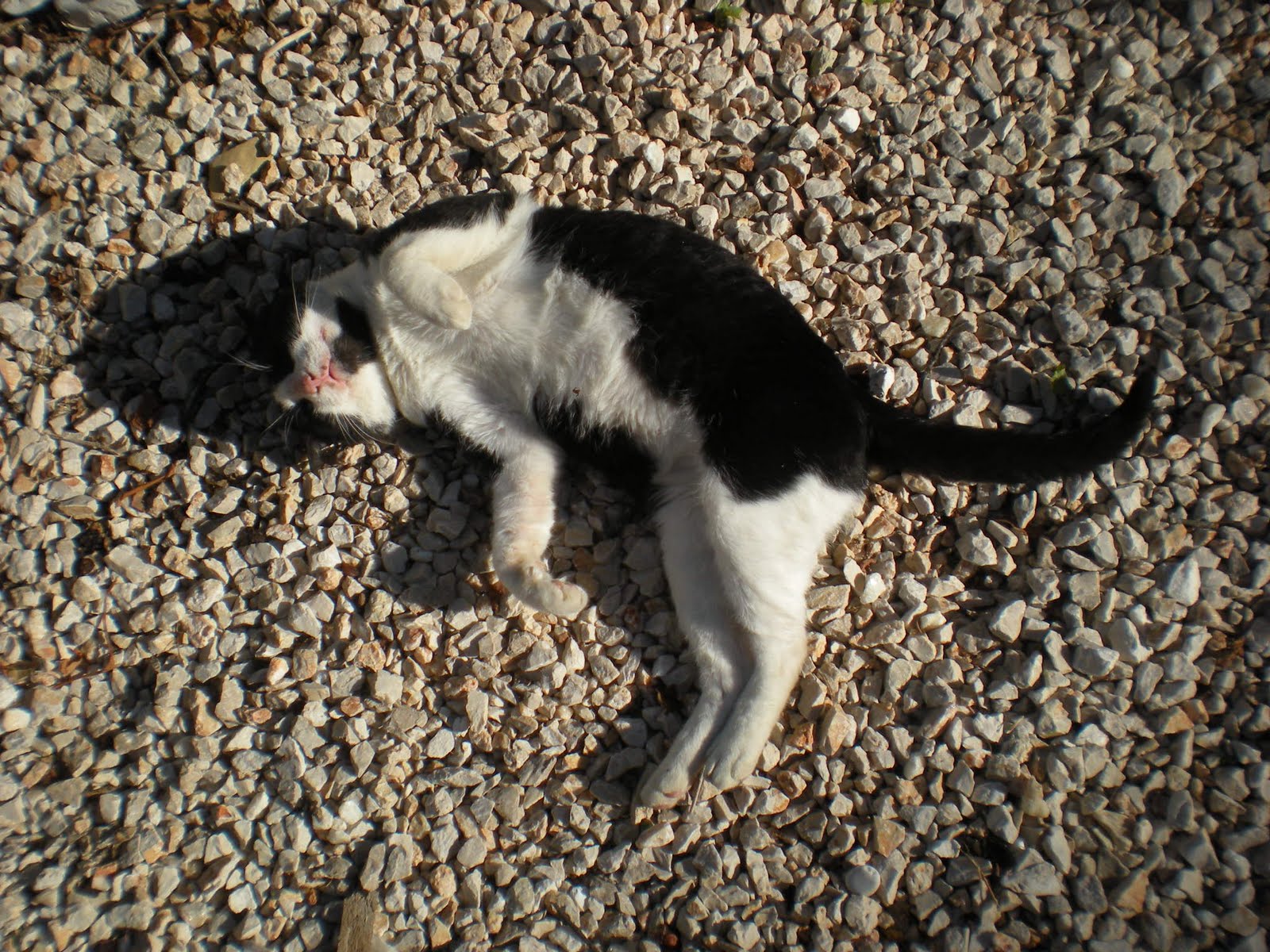
A sleeping cat in a country of economic crisis. Life has to go on...
The old bent down ladies in black going on with their daily routine.
I watch a leave fall.
Smell the fresh laundry.
I was never rich.
I never had a pool.
I never knew anyone with a pool.
I never wished to have one.
Being rich, that is what I am now.
Sitting here writing in the greek mountains.
Watching a cat sleep.
Smoking and drinking Ouzo before lunch.
Is it a privilege?
a special right, advantage, or immunity granted or available only to a particular person or group of people.
Well, tomorrow I will wear a bikini and make a nasty piece about a woman who does not care about banks, national debts, BNP and the IMF.
who loves the female artist?
another female artist.
sometimes a male artist who just loves this female artist (as a person and/or as an artist)
but look at the rest of the system.
the art bitches, sorry, the art women who work within arts, curators, gallerists, museumpeople ..they like male artists, gay male artists and hetero male artists because they love them back.
the female artist can be tricky. difficult. make difficult statements. be uncomfortable somehow. talk about periods or about annoying feminism.
the male curator etc then…they favor male artists because they are buddies. and often they are gay so they favor other gay artists…
so what is left for the female artists?
hm
another female artist.
sometimes a male artist who just loves this female artist (as a person and/or as an artist)
but look at the rest of the system.
the art bitches, sorry, the art women who work within arts, curators, gallerists, museumpeople ..they like male artists, gay male artists and hetero male artists because they love them back.
the female artist can be tricky. difficult. make difficult statements. be uncomfortable somehow. talk about periods or about annoying feminism.
the male curator etc then…they favor male artists because they are buddies. and often they are gay so they favor other gay artists…
so what is left for the female artists?
hm
memoires from a greek residency
yes, imagine how people lived without electricity.
they did not stay up in the late hours. they went to sleep when it got dark.
Im sitting here in candlelight. Alone. In the greek mountains. There is thunderstorm.
I can not see the mountains - they are covered in mist.
But I have my MacBook Pro - thanks Steve Jobs.
It's giving me a little light. I just hope the 77% of battery will last for a while.
I hope my 6 candles will last.
I hope the dear electricity comes back soon.
What if I need to have a shit?
I can't find the toilet in the dark.
I will poo in a pot.
what is this whole glamour stuff? I mean in the art scene?
are artists glamourous or are the hang arounds the glam ones?
I mean…artists who often deal with tough issues, concern their work about serious things, reveal themselves almost to the bone etc - how could they in the end be glamorous?
I mean yes, in one sense probably, in their leisure time…
or perhaps there are the different ones…the glam artists and the serious ones.
And what about shyness? I always find artists to be quite shy. If they are not drunk or on drugs. Quite introverted actually. Not wanting to be the center of attention…
I am 36. an artist. currently sitting alone in a house in the mountains of Lefkada, Greece. I am working. This is not glamorous.
Subscribe to:
Posts (Atom)